



How to create a fitness app: Main steps, features, and cost
 How to create a fitness app: Main steps, features, and cost
The fitness sector is undergoing significant transformations globally and is now embracing digital solutions by creating apps and providing users the convenience of workout guidance, tracking activities, and personalized coaching. The fitness applications have become the fastest-growing sectors for both iOS and Android, due to the constant increase in the number of users who prioritize convenience and health.
In this guide, you will learn all the steps to create a fitness app, the important features, and the estimated cost of developing a top-notch fitness platform. Collaborating with a fitness app development company can provide you with professional advice, flexibility, and the technical backbone to create a thriving business for the long term. Whether you are planning a simple MVP or a full-blown fitness ecosystem, this guide will cover everything required to turn your idea into reality.In 2026, the fitness app industry will be supported by stronger AI capabilities, more seamless interaction with IoT-enabled wearables, and faster data processing on the cloud. These technologists provide accurate analytics, hyper-personalized suggestions, and perfectly timed cross-device synchronization. The businesses in this market benefit from the health-tech infrastructure by aligning with user trends and taking proactive measures.
2. Why Build a Fitness App in 2026?
Mobile phone dependency among users is increasing due to the demand for real-time tracking, data-informed insights, and personalized workout coaching, as well as the need for digital fitness solutions. In addition, the emergence of health-related apps with the advancement in mobile devices, sensors, and wearables has made it easy for all age groups to benefit from them.
In 2026, the fitness app industry will be supported by stronger AI capabilities, more seamless interaction with IoT-enabled wearables, and faster data processing on the cloud. These technologists provide accurate analytics, hyper-personalized suggestions, and perfectly timed cross-device synchronization. The businesses in this market benefit from the health-tech infrastructure by aligning with user trends and taking proactive measures.
3. Types of Fitness Apps
Fitness applications are separated into several categories, each one is developed for specific users and the data processing. Selecting the correct type is crucial for determining the app’s architecture, features, and integration needs.
Activity & Step Tracking Apps: These are designed to collect data such as the count of steps performed, distance walked, heart rate, and sleeping habits by means of its sensors and APIs for wearables.
Workout & Training Apps: Provide customized routines with video-guided training programs and in-depth performance analytics with growth tracking.
Diet & Nutrition Apps: Provides calorie count, macronutrient distribution programs, meal schedule, and food databases.
Mental Wellness & Meditation Apps: services consist of directed meditation, stress level tracking, mindfulness exercises, and mood monitoring.
Yoga & Pilates Apps: Showcase posture libraries, feature session timers, and develop personalized practice schedules.
All-in-one comprehensive fitness platforms: Activity tracking, workout modeling, diet consultancy, and analytics are merged in one system of basic personalization using advanced technology.
Key Steps to Create a Fitness App
Define the Purpose & Target Audience
The purpose of the app should be identified to guide users in their workouts, track fitness or nutrition, or offer all these as a solution. User types should be listed, such as newcomers, gym-goers, athletes, or employees involved in health initiatives designated by the company that will outline the feature, data model, and personalization logic.
Research Competitors
Discover the functionality gaps, UX trends, and monetization plans by researching the best fitness applications. Compare functionality, device compatibility, and performance statistics to highlight the differences in these areas.
Choose Core Features
Develop a minimum viable product (MVP) focusing on the primary features only. Indicate the data inputs, relevant APIs, backend structure, and UI parts. Any additional features can be added after the approval and user engagement are validated.
Pick the Right Tech Stack
Opt for either the native (Swift/Kotlin) or the cross-platform (Flutter, React Native, .NET MAUI), considering the financial aspect, performance needs, and project time. Also, select the backend tech stack, the cloud, and real-time database solutions, as well as the third-party service integration, including HealthKit, Google Fit, or SDKs for wearables.
UI/UX Design
Develop user flows, configure the visual layout of the dashboard, and specify the interactions. Prioritize accessibility, minimum navigation obstruction, and clear metrics as the main issues. Prototypes help in testing usability before full-scale development.
Development & Testing
Set up the backend development for User management, data storage, analytics, notification systems, and a secure API. The Main Focus should be on the frontend development for high-performance optimization and data-heavy tracking features, and secure data handling that complies with the relevant standards throughout the project.
Launch & Collect Feedback
Conduct device compatibility, integration, and performance tests. Check that the integration of wearable devices, tracking precision, and data syncing work without any delays or errors.
Scalability & Maintenance
Publish the application on appropriate app stores and ensure that ASO elements are properly incorporated. Monitor user actions, retention rates, and feature use. Always improve performance, eliminate bugs, and offer updates based on real user data.
Essential Features of a Fitness App
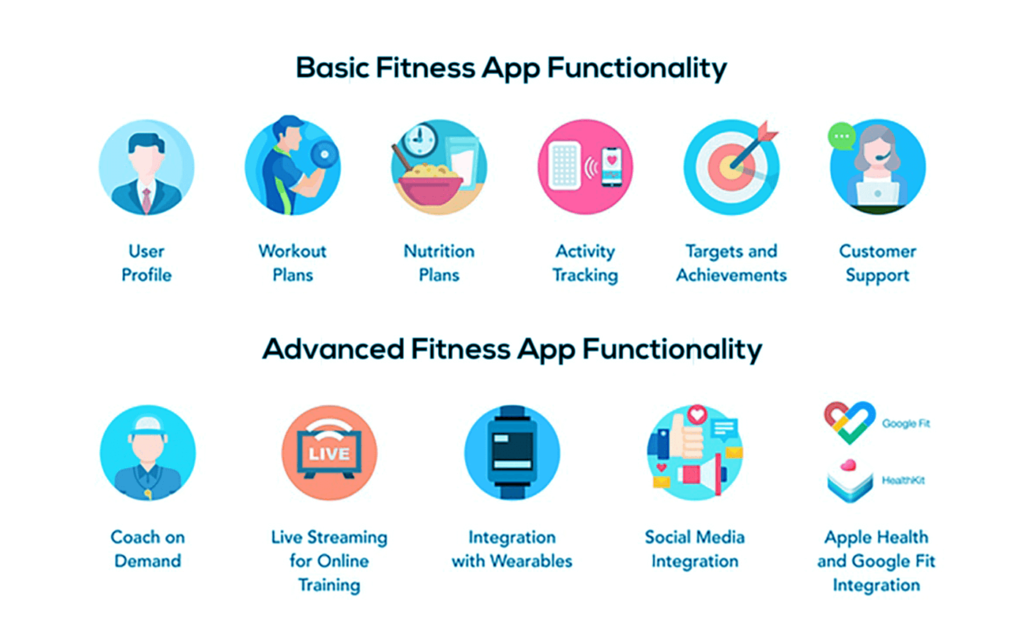
The fitness app should track data accurately and offer a personalized user experience daily. The following components form the core of a high-performing fitness platform:
Activity and Workout Tracking
Users can log their activities either automatically or manually, such as activity tracking, workouts, distance traveled, calories burned, sleep cycles, and heart rate. Devices will capture this information in real time by using sensors, accelerometers, GPS, and APIs for wearables.
Personalized Training Plans
Use AI algorithms or rule-based logic to make personalized workout recommendations according to user goals, performance history, and biometric inputs.
Wearable Device Integration
The app will allow syncing with devices such as Fitbit, Apple Watch, and Garmin, and other IoT-enabled wearables. Data collection will be unified by HealthKit, Google Fit, and proprietary SDKs.
Social and Community Features
The features include Leaderboards, friend challenges, activity-sharing options, and group programs to enhance user experience and motivation.
Push Notifications and Reminders
It generates diverse alerts for the users, like scheduled workouts, hydration reminders, goal milestones, and inactivity prompts. Moreover, it supports personalization according to the user’s behavior patterns.
Progress Insights and Analytics
Users can access dashboards, charts, and data summaries to recognize their progress in fitness journeys. Performance trends, goal tracking, and predictive analytics are provided where applicable.
Cost of Creating a Fitness App
The cost of a fitness app depends on feature complexity, platform, integrations, and development scope. Below is a concise breakdown.
Cost Breakdown by App Complexity
Fitness app development cost depends on the level of complexity: a basic application can cost $15,000–$30,000 for tracking activities and showing major statistics; a mid-range app can cost between $30,000–$60,000 for AI-generated plans, wearable integration, and data analysis while the premium app cost could go to $60,000 and more which offers AI personalization, social/community features, and a seamless transition between devices.
Cost Factors
- Platform: Native or cross-platform affects performance and budget.
- Features: Tracking, AI recommendations, social/community elements drive cost.
- Integrations: Wearables, third-party APIs, and payment gateways add complexity.
- UI/UX Design: Dashboard layouts, onboarding flows, and visual clarity impact resources.
- Backend Infrastructure: Cloud hosting, databases, and security compliance influence expenses.
- Maintenance: Updates, bug fixes, and performance optimization require ongoing investment.
Estimated Timelines
Estimated Timelines
- Design and prototyping: 3–6 weeks.
- Frontend and backend development: 2–6 months.
Testing, QA, and deployment: 3–8 weeks.
Final Thoughts
Building a fitness app in 2026 requires a clear strategy, essential features, and realistic cost planning. Partnering with a fitness app development service ensures technical accuracy, scalability, and timely delivery. Early investment in a well-designed, feature-rich app positions businesses to capture market share, engage users, and generate sustainable revenue in a rapidly growing digital fitness ecosystem.