



Why Small Bathrooms Feel Bigger After One Simple Door Change
Small bathrooms have a reputation for being unforgiving. Every decision feels magnified. A few centimetres in the wrong place can affect how the room is used every single day. People often focus on fixtures first. Slimmer vanities. Wall-hung toilets. Lighter tiles. Mirrors that promise visual expansion. All of these help, but they rarely address the main source of tension.
Movement is the real issue.
In many compact bathrooms, the door dictates how the space works more than any fixture. It swings inward, competing with the sink. Or it opens outward, colliding with hallway traffic. Either way, it introduces a constant negotiation. You step in, step aside, close the door carefully, then reposition yourself again. Over time, this awkward choreography becomes normal, even though it never feels good.
What makes bathrooms particularly sensitive is that they are already dense spaces. Plumbing, storage, and circulation are packed into a small footprint. There is little tolerance for elements that demand extra clearance. A swinging door does exactly that. It claims floor area without offering anything in return.
This is why many people are surprised by how different a bathroom feels after changing the door rather than the fixtures. Removing the swing instantly alters how the room behaves. You enter directly. You turn freely. You stop thinking about where the door is at all.
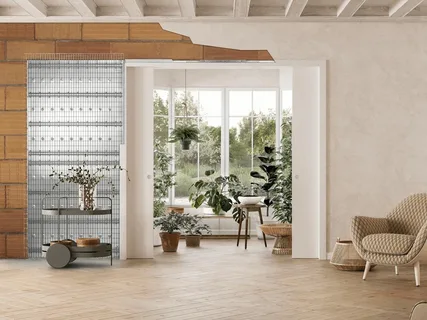
The reason this works is simple. Sliding pocket doors remove the door leaf from the room entirely when open. The wall becomes predictable again. That predictability creates a sense of space, even when the actual dimensions stay the same.
Bathrooms benefit more than most rooms because they rely heavily on clear movement paths. When the door no longer interrupts those paths, the room feels calmer and easier to use. This is often described as feeling “bigger,” but what people are responding to is reduced friction, not added area.
There is also a visual shift. In a small bathroom, sightlines matter. A swinging door breaks the room into fragments. A pocketed door allows the eye to take in the full width of the space at once. That continuity makes the room feel less boxed in.
Another advantage appears in layout flexibility. Without a door swing to avoid, vanities can be placed more logically. Storage can extend closer to the entry. Towel rails and hooks can be positioned without fear of collision. These changes are small, but they accumulate.
This door choice is especially effective in ensuites, powder rooms, and bathrooms off narrow corridors. In these locations, a traditional door often creates congestion beyond the bathroom itself. Removing the swing improves both spaces at once.
Concerns about privacy and sound insulation are common. Modern pocket systems, when properly installed, can seal effectively. The door still closes fully. The difference is not in what the door does, but in where it waits when not needed.
Installation does require planning. Wall cavities must be clear of plumbing and services. In renovations, this may influence which wall is suitable. These are practical considerations, but they are usually solvable with early assessment.
What often holds people back is habit. Bathrooms have had swinging doors for decades, so alternatives feel unusual. Once installed, however, the change feels obvious in hindsight. The room simply works better.
Importantly, this is not a decorative upgrade. It does not rely on trends or finishes. It changes behaviour. That is why the effect feels lasting rather than cosmetic.
For homeowners dealing with a bathroom that feels cramped despite careful design choices, the solution is not always to shrink fixtures further. Sometimes the room needs to stop accommodating a moving obstacle.
Used thoughtfully, sliding pocket doors shift the experience of a small bathroom from careful to comfortable. They do not add luxury in the traditional sense. They add ease. And in a space used every day, that ease quickly becomes the thing people value most.