
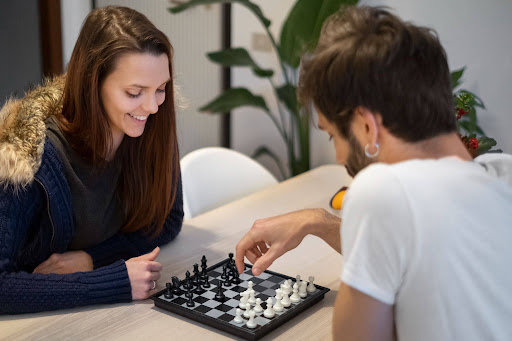
Learning chess becomes exciting when each move starts to make sense. At first, the board may seem complicated. Once you understand the basics, you can spot opportunities, protect pieces, and plan ahead. Choosing the best beginner chess course can help you learn concepts in a sensible order instead of trying to master everything at once.
The goal is not simply to move pieces legally, but to understand what each move achieves. Learning the board, developing pieces, and practicing useful habits can turn basic knowledge into smarter decisions.
Understand How Each Piece Shapes the Game
Chess is played between two opponents on a board of 64 squares. Each player begins with 16 pieces, and the objective is to checkmate the opposing king. Rooks move horizontally and vertically, bishops travel diagonally, knights jump in an L-shape, and queens combine the movements of rooks and bishops. Kings move one square in any direction, while pawns advance forward and capture diagonally.
Learning movement is only the first step. Players must also recognize how pieces interact and which squares they control. A knight near the center may influence several important squares, while a bishop with an open diagonal can pressure the opponent’s position. Thinking about activity, protection, and coordination helps you form a plan.
-
Develop Your Pieces With Purpose
Bring knights and bishops into active positions instead of moving the same piece repeatedly without a clear reason. Development gives your pieces more influence over the board and prepares them to support attacks or defend important squares. Consider whether each move improves the piece and your position.
-
Compete for the Center
The central squares give pieces access to many parts of the board. Controlling them can make it easier to move between the kingside and queenside, support an attack, or respond to a threat. Pawns and minor pieces help establish control, but avoid creating easy targets.
-
Keep Your King Safe
King safety matters throughout the game. Castling can move the king away from the center and bring a rook into play. Avoid weakening the pawns around your king unnecessarily, and notice when your opponent’s pieces begin aiming toward your castled position.
-
Recognize Tactical Patterns
Tactics are short sequences that win material or create checkmate threats. A fork attacks two or more targets at once, while a pin restricts a piece from moving because doing so would expose something more valuable. A skewer attacks a valuable piece that may move and reveal another target behind it.
-
Make Pieces Work Together
Strong positions depend on cooperation between pieces. A rook may control an open file while a bishop targets a weak square, or a knight may support a pawn advance. Check that your pieces support one another before attacking. An unsupported attacker may simply become an easy target.
-
Examine Captures Before Committing
A piece that appears free to capture may be defended by another piece or protected by a tactical trick. Before taking it, count the likely exchanges and check whether your own piece will be trapped. Careful calculation can prevent a promising position from turning into a disadvantage.
Build a Reliable Thinking Routine
Beginners often make mistakes because they focus only on their own plans. A more useful approach is to pause after every opponent’s move and ask what has changed. Look for new threats, undefended pieces, and squares that have become available. Then consider candidate moves rather than playing the first idea that comes to mind.
Learners comparing the best online chess lessons in the USA should look for teaching that explains why moves work, offers practical exercises, and helps students review their decisions. Understanding opening ideas is more valuable than memorizing moves when an opponent surprises you. A repeatable thinking routine gives beginners a way to handle unfamiliar positions without relying entirely on memory.
- Check whether your king is in danger.
- Identify the opponent’s checks, captures, and threats.
- Look for pieces that are undefended.
- Consider whether your move improves a piece or creates a threat.
- Calculate the opponent’s most likely response.
- Check that your chosen move does not lose material unnecessarily.
These checks cannot guarantee a perfect move, but they can prevent errors and become natural with practice.
Turn Game Reviews Into Practical Progress
Playing regularly is useful, but improvement also depends on what you learn after each game. Review the moments when you lost material, missed a tactic, or allowed an attack to develop. Try to identify the decision that caused the problem and find an alternative you could have considered. Review mistakes constructively to recognize similar positions later.
Set a clear goal for each practice session. You might solve fork puzzles, practice checkmate patterns, or focus on developing pieces during the opening. After a game, write down one lesson to remember in your next match. Puzzles strengthen pattern recognition, while games test whether you can apply those ideas under pressure. Focused practice and honest review can make your thinking more accurate.
Conclusion
Moving from basic moves to smart strategy takes patience, focused practice, and a willingness to learn from mistakes. By developing pieces purposefully, protecting the king, spotting tactical patterns, and reviewing games, beginners can build a foundation for stronger decisions.
For learners seeking an online chess academy in the USA, Chessbrainz offers structured chess education across beginner, intermediate, advanced, and master levels. Its Grandmaster-curated curriculum, interactive practice, game analysis, and online tournaments provide opportunities to learn concepts and apply them through play. With a progressive learning path, Chessbrainz helps students strengthen their fundamentals and work towards becoming more confident, thoughtful players.