


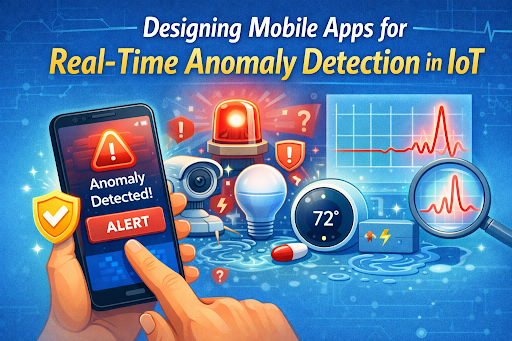
Designing Mobile Apps for Real-Time Anomaly Detection in IoT
The surge of connected devices has redefined how industries operate, uncovering new opportunities to optimize performance, enhance safety, and drive predictive insights. As IoT ecosystems scale, the value of real-time anomaly detection becomes non-negotiable—ensuring systems remain secure, reliable, and resilient. Mobile apps now serve as the frontline interface for monitoring these networks, enabling teams to respond instantly to irregularities that may impact operations. Designing such apps, however, requires a thoughtful blend of UX strategy, data engineering, edge intelligence, and stringent security practices.
This blog unpacks how to architect mobile applications capable of real-time anomaly detection in IoT environments, highlighting key principles, design strategies, and implementation best practices for modern enterprises.
Understanding Real-Time Anomaly Detection in IoT
Anomaly detection in IoT revolves around identifying readings, patterns, or behaviors that deviate from normal operating thresholds. These deviations may signal hardware failures, cyber intrusions, unsafe conditions, or inefficiencies within a process.
IoT-generated data is massive, continuous, and highly contextual—making real-time detection a sophisticated challenge. Mobile applications bridge this complexity by converting raw IoT telemetry into actionable intelligence. Whether it is a smart factory monitoring machinery vibrations or a hospital supervising patient vitals, mobile-first anomaly detection enables rapid decision-making and reduces downtime.
Why Mobile Apps Play a Central Role
Mobile apps bring anomaly detection to the user in a frictionless, accessible manner. Their ubiquity and always-on connectivity position them as mission-critical tools for distributed teams who need stream-based updates anywhere, anytime.
Key strengths of mobile platforms include:
- Instant Notifications: Push alerts ensure anomalies never go unnoticed.
- On-the-Go Decision Making: Field teams gain mobility without sacrificing access to insights.
- Sensor Integration: Mobile devices can combine built-in sensors with IoT data for hybrid detection.
- Contextual Awareness: Location, motion, and usage patterns refine detection accuracy.
When thoughtfully designed, mobile apps serve as a responsive command center that accelerates operational clarity.
Architectural Foundations for Real-Time Anomaly Detection
Designing a mobile app for real-time anomaly detection requires a multilayered architecture aligned around data speed, accuracy, and reliability.
1. Device & Sensor Data Collection Layer
This is the source of truth where IoT devices continuously stream readings. Data can originate from:
- Industrial sensors
- Wearables
- Environmental modules
- Smart meters
- Medical devices
Ensuring device compatibility, low-latency transmission, and secure onboarding is essential. At this level, many organizations rely on an iot development company to establish robust connectivity frameworks and scalable data pipelines.
- Edge Processing Layer
To support real-time responsiveness, edge computing plays a pivotal role. Instead of routing all data to the cloud, essential computations occur at the device or gateway level.
Benefits include:
- Reduced latency
- Lower network congestion
- Enhanced reliability
- Faster anomaly detection
Edge models can pre-process, filter, and classify data before sending refined insights to the mobile app.
- Cloud or Hybrid Analytics Engine
The cloud hosts advanced analytics pipelines, enabling:
- Machine learning-based anomaly detection
- Multi-sensor correlation
- Threshold-based rule engines
- Predictive maintenance algorithms
A hybrid approach combining cloud-scale analytics with edge inference ensures both precision and speed.
- Real-Time Communication Framework
For mobile apps, a seamless data-streaming layer is the backbone of real-time functionality. Common solutions include:
- MQTT brokers
- WebSockets
- Server-Sent Events (SSE)
- Event-driven microservices
This infrastructure ensures continuous, reliable delivery of anomaly-related information directly to end users.
Key UX Principles for Designing Effective Anomaly Detection Apps
Real-time detection is only useful if users can clearly understand and act upon the information. UX plays a significant role in reducing cognitive load and presenting anomalies meaningfully.
1. Prioritize Alert Visibility
Alerts should stand out visually, utilizing structured hierarchies, color semantics, and concise messaging. Critical alerts must be instantly distinguishable from general notifications.
2. Offer Contextual Details on Demand
Users should not receive vague alerts. Provide actionable context such as:
- Severity levels
- Historical data comparisons
- Device location maps
- Probable root causes
This reduces guesswork and improves decision-making confidence.
3. Design for Role-Specific Dashboards
Engineers, supervisors, technicians, and managers all require different insights. Personalized dashboards prevent clutter and enhance usability.
4. Enable Smooth Data Exploration
Interactive charts, trend timelines, and filtering capabilities allow users to understand anomalies from multiple angles.
Integrating Machine Learning for Smarter Detection
Machine learning enhances anomaly detection far beyond rule-based thresholds. Mobile apps should be designed to integrate with ML models that:
- Understand sensor behavior
- Detect subtle deviations
- Adapt to system evolution
- Minimize false positives
Popular ML approaches include:
- Autoencoders
- Isolation forests
- Time-series forecasting models
- Clustering algorithms
The model selection depends on the use case, data volume, and anomaly complexity.
Security Considerations for Mobile IoT Anomaly Detection Apps
Security is paramount because anomaly detection data often relates to critical systems. The app must enforce security controls at every layer:
1. Encrypted Data Transmission
TLS, secure sockets, and encrypted payloads ensure data integrity.
2. Strong Device Authentication
Multi-factor authentication, biometric verification, and token-based access minimize unauthorized entry.
3. Secure APIs and Microservices
Rate limiting, authentication policies, and secure gateways protect backend services from misuse.
4. Compliance with Industry Standards
Depending on the sector, organizations may adhere to HIPAA, ISO 27001, GDPR, and other frameworks.
Testing and Performance Optimization
Anomaly detection apps must undergo rigorous testing due to the high stakes of real-time responsiveness.
Key testing approaches include:
- Latency testing: Ensures real-time accuracy
- Load testing: Verifies scalability during peak device traffic
- Model performance validation: Confirms anomaly detection precision
- Usability testing: Ensures the app simplifies decision-making
Battery and CPU optimization are equally important to prevent device drain, especially when handling continuous data streams.
Real-World Applications Across Industries
1. Manufacturing
Detecting abnormal vibrations, overheating, or pressure deviations reduces downtime and prevents equipment failure.
2. Healthcare
Mobile apps can flag anomalies in patient vitals, enabling rapid clinical intervention and remote monitoring.
3. Smart Buildings
Energy usage spikes, water leaks, or unauthorized access attempts trigger instant alerts.
4. Transportation & Logistics
Vehicle telematics can detect route deviations, engine irregularities, or unsafe driving behaviors.
5. Agriculture
IoT sensors monitoring crops, soil, and weather provide anomaly insights that protect yields.
Future Trends in Mobile Anomaly Detection for IoT
As IoT ecosystems expand, several next-generation enhancements will redefine anomaly detection:
- Federated learning for privacy-preserving model training
- Context-aware anomaly detection using hybrid signals
- Adaptive AI models with self-learning capabilities
- More intelligent notification systems powered by natural language insights
Mobile apps will evolve into intelligent decision ecosystems rather than simple alerting tools.
Conclusion
Designing mobile apps for real-time anomaly detection in IoT requires a balance of intuitive UX, strong analytical foundations, reliable data pipelines, and secure communication frameworks. As connected ecosystems continue to scale across industries, these apps will play a central role in ensuring operational stability, safety, and efficiency. Organizations that craft their mobile IoT experiences with precision will accelerate their shift toward predictive operations and data-driven decision-making.
FAQs
1. What is real-time anomaly detection in IoT?
It refers to identifying unusual or abnormal patterns in sensor data instantly, allowing teams to react quickly to potential risks or system failures.
2. Why are mobile apps important for anomaly detection?
Mobile apps deliver instant visibility, push alerts, and interactive insights, enabling operational teams to detect and resolve issues from anywhere.
3. How does machine learning improve anomaly detection?
ML models analyze historical and real-time patterns, identify subtle deviations, and reduce false positives, making detection more accurate.
4. What are common communication protocols for real-time IoT data?
Technologies like MQTT, WebSockets, and event-driven APIs enable low-latency data streaming between devices, servers, and mobile apps.
5. Which industries benefit most from anomaly detection apps?
Manufacturing, healthcare, logistics, agriculture, and smart infrastructure gain major advantages through enhanced safety, reduced downtime, and operational optimization.