
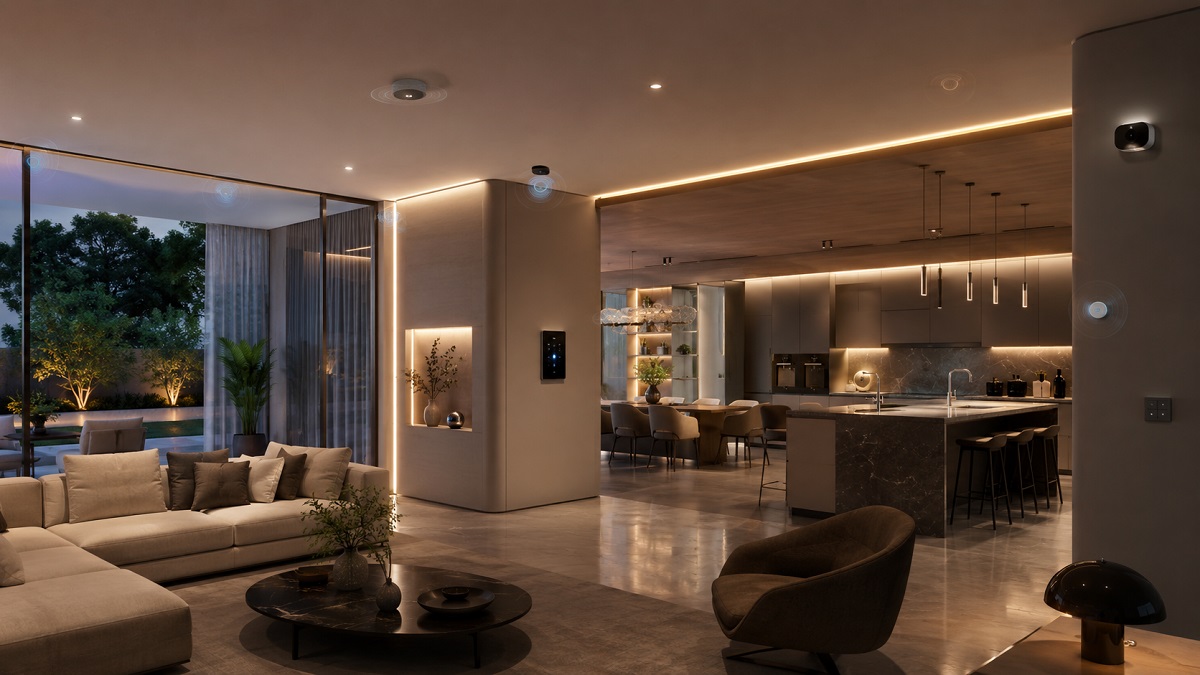
But in the higher end of the residential architecture spectrum, a radical change is taking place: moving from visible gadgetry of early automation to the invisible smart home. These days, a home’s intelligence isn’t measured by how many touchscreen panels are installed in the walls of its high-net-worth clientele.
Rather, luxury is one whose environmental response is for the benefit of the occupants, and, consequently, without notice. The idea is to gain a pure architectural canvas with cutting-edge technology being a silent, intuitive concierge.
Acoustic Mastery Without the Footprint
High-fidelity sound is an essential part of high-end interior design, but often a large freestanding speaker or standard grilled ceiling input detracts from a room’s visual flow. The modern solution is the integration of acoustic plaster. The role of the interior designer from Cape Town or from other places is essential for designing such features in the home.
Larger, flat panel speakers are directly attached to the wall studs and covered in a thin skim coat of joint compound, paint, or Venetian plaster.
These panels vibrate with high precision at a low frequency, “transmitting” pure, complete frequency sounds directly through the panel itself. The outcome is a soundscape that permeates the room, with no visible speaker wires or grilles.
Architectural Camouflage for Displays
A large, silent television set can really ruin the style of a formal lounge or bedroom. Elite designers solve this issue with special silent motorized art lifts that retract the display behind museum-quality canvas art when it’s not being used.
Or, customized 2-way dielectric mirror glass can transform ultra-high-definition screens to disappear all the way behind a handsome vanity or mantle mirror. The display will slice through the glass clearly when on, and become an ideal reflective surface when off.
Clutter-Free Subsurface Controls
Individual switches for lights, HVAC, and motorized drapes are gone, replaced by clean, continuous planes for the fine art curation. Control hardware can be located in completely separate mechanical rooms when using centralized lighting panels. Instead, designers use low-voltage, flush-mounted keypads with custom metals or stone.
More advanced are capacitive touch sensors that are placed directly under hard marble countertops or bespoke wood paneling. Simply select one of the stone islands’ veins to trigger a complete ambient scene for the whole dining room.
Proactive Climate and Shadow Lines
The traditional, industrial-style air conditioning vents and bulkheads can be a huge blow to a minimalist ceiling plan. The answer is to create thin linear slot diffusers that fit exactly the architectural shadowing lines of the room.
These hidden HVAC systems connect with undetectable occupancy sensors and local weather monitoring. The role of the interior designer from Cape Town or other places is to help to design with modern features.
When the building receives significant afternoon solar gain through a glass façade, the home responds automatically by dropping motorized pocket shades in the evenings into recessed holes in the ceiling, which reduces cooling loads and prevents harmful UV rays from harming precious art.
Conclusion
Combining the best aspects of aesthetics and advanced automation demands a technology embedded within the structural fabric of the estate. With hidden engineering from the start, this interior is nothing more than a true work of design and provides modern convenience without asking to be seen.