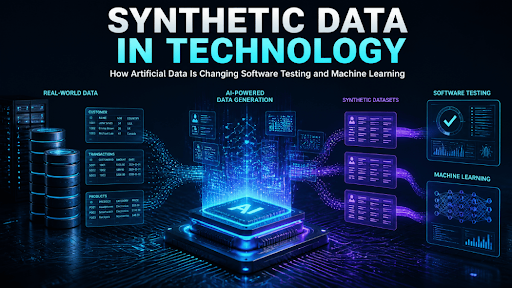
Discover how synthetic data supports software testing, machine learning, data privacy, and AI development with practical business applications.
What Is Synthetic Data?
Technology companies need large amounts of data to build, test, and improve digital products. Software developers use datasets to check application performance. Machine learning engineers need examples to train and evaluate models. Businesses also require reliable information to understand customer behavior and improve their services.
However, collecting real-world data is not always easy. It can involve privacy concerns, high costs, limited availability, and legal restrictions. Some datasets also contain sensitive customer information that organizations cannot freely share.
Synthetic data offers another approach.
Synthetic data is artificially generated information that reflects selected patterns and characteristics of real-world data. It can include names, transactions, medical records, customer activities, images, and other information. Unlike copied production records, properly generated synthetic datasets are created to support specific testing, development, or research requirements.
For example, a banking application needs transaction records to test its payment system. Developers can create artificial customer profiles, account balances, transaction amounts, and payment histories. These records can resemble realistic banking activity without directly using actual customer transactions.
This makes synthetic data useful across software development, cybersecurity testing, artificial intelligence, healthcare research, and business analytics.
How Is Synthetic Data Generated?
Synthetic data is created through different methods. The right approach depends on the type of information, its intended use, and the level of realism required.
Some organizations generate artificial records using predefined rules. Others use statistical models or machine learning techniques to reproduce patterns found in existing datasets.
Here are the main approaches.
1. Rule-Based Data Generation
Rule-based generation uses predefined conditions to create artificial information.
For example, an ecommerce company may need customer records for testing its checkout process. Developers can define rules for customer names, email formats, product prices, shipping addresses, and order amounts.
The system then generates records that follow those rules.
This method works well when developers need predictable information for software testing. It is also easier to control because the generated values follow clearly defined conditions.
2. Statistical Data Generation
Statistical methods create synthetic information by learning numerical patterns from an existing dataset.
Suppose a retail company wants to test its sales forecasting software. Its original records contain product prices, order quantities, seasonal demand, and purchase frequency.
A statistical model can learn these distributions and generate new records with similar characteristics.
The generated dataset can help developers test analytical systems without repeatedly using the original business records.
However, statistical similarity does not guarantee that every generated record represents realistic customer behavior.
3. Machine Learning-Based Generation
Machine learning models can learn relationships between different data points and generate new examples.
Generative Adversarial Networks (GANs) and Variational Autoencoders (VAEs) are two techniques used for this purpose.
GANs use two neural networks. One generates synthetic samples, while the other evaluates whether those samples resemble the training data. Both networks improve through repeated training.
VAEs learn compressed representations of existing information. They use these representations to generate new samples with similar underlying patterns.
These approaches are useful when working with complex datasets, including images, medical information, and financial records.
4. Generative AI-Based Data Creation
Generative AI can also create synthetic text, images, conversations, and structured records.
For example, a software company developing a customer support platform may need thousands of sample conversations. A generative model can produce different customer questions, responses, complaints, and support scenarios.
Developers can use these examples to test chatbot behavior, search functions, and customer service workflows.
The generated information still needs review. Incorrect patterns, unrealistic examples, and repeated outputs can affect testing quality.
Why Is Synthetic Data Becoming Important in Technology?
Data availability directly affects software development and machine learning projects. When useful information is difficult to access, testing and development can become slower.
Synthetic data helps address several common problems.
Better Data Privacy
Real customer datasets may contain names, contact details, financial information, and other sensitive records.
Sharing such information with external developers or testing teams creates additional privacy risks.
Synthetic data can reduce the need to expose actual customer records during development. Properly generated datasets may support testing without including identifiable personal information.
However, synthetic data is not automatically anonymous. Some generation methods can reproduce information from their training datasets. Organizations must check for memorized records, data leakage, and re-identification risks before sharing synthetic datasets.
Faster Software Testing
Software teams need different types of data to test application features.
A payment application requires successful transactions, failed payments, refunds, and unusual purchase patterns. A healthcare platform may need patient profiles, appointment records, and sample diagnostic information.
Creating every test record manually takes time.
Synthetic data generation can produce large datasets quickly. Developers can also create specific scenarios to test application behavior under different conditions.
Teams working with AI tools for software development can explore synthetic datasets alongside automated testing workflows to improve development and debugging processes.
Access to Rare Scenarios
Some real-world events happen very rarely. This creates difficulties when developers need to test how software responds to unusual situations.
For example, a fraud detection system may need examples of suspicious transactions. A self-driving vehicle system needs examples of unusual road conditions. A cybersecurity application may require different attack patterns.
Synthetic data allows developers to create controlled examples of these situations.
This can improve test coverage, although artificial scenarios should still be compared with real-world conditions.
Reduced Dependence on Real-World Data Collection
Collecting, cleaning, labeling, and organizing real datasets can require significant resources.
Synthetic data can reduce some of this workload, particularly during early development and testing.
Businesses can generate sample records based on specific requirements instead of collecting fresh production data for every development task.
This does not mean synthetic datasets can replace all real-world information. Real data remains important for validating whether an application performs accurately in actual conditions.
Real-World Applications of Synthetic Data
Synthetic data has practical applications across several technology-driven industries. Its value depends on how closely the generated information matches the requirements of a particular project.
1. Software Development and Application Testing
Software developers regularly test applications before releasing new features.
Consider a company building an online shopping platform. The development team needs sample information about customers, orders, payment methods, product categories, and delivery statuses.
Using synthetic data, developers can create thousands of sample records for different testing conditions.
They can check whether the application handles large order volumes, processes refunds correctly, and displays accurate customer information.
Synthetic datasets also help test database queries, APIs, user interfaces, and reporting systems.
2. Healthcare and Medical Research
Healthcare organizations handle sensitive patient information. Researchers need reliable datasets to study medical conditions, treatment outcomes, and disease patterns.
Synthetic medical records can help researchers develop analytical tools and test healthcare applications.
For example, a hospital software provider may generate artificial patient profiles to test appointment management, electronic health records, and diagnostic reporting features.
Researchers can also explore synthetic medical images for developing and evaluating image analysis systems.
However, synthetic medical data must be carefully validated. Artificial records may not capture important clinical relationships or rare medical conditions accurately.
3. Banking and Financial Services
Banks and financial institutions process millions of transactions. Their systems must identify suspicious activities, prevent fraud, and maintain accurate records.
Synthetic transaction data can help developers test fraud detection systems.
For example, a financial technology company can generate artificial records representing normal purchases, unusual withdrawals, repeated transactions, and suspicious payment patterns.
These examples help test whether the software identifies potential risks.
Financial organizations can also use synthetic datasets to test payment gateways, loan management systems, and transaction reporting platforms.
4. Artificial Intelligence and Machine Learning
Machine learning models depend on data quality and coverage.
If a training dataset lacks certain examples, the model may perform poorly when it encounters unfamiliar situations.
Synthetic data can help fill some of these gaps.
For example, an image recognition system may need thousands of images showing different lighting conditions, angles, and backgrounds.
Synthetic image generation can provide additional training examples. Developers can use them to test how the model responds to different visual conditions.
The same approach applies to text classification, speech recognition, fraud detection, and predictive analytics.
However, adding more artificial examples does not automatically improve model accuracy. Poorly generated data can introduce errors and reinforce existing biases.
5. Autonomous Vehicles and Robotics
Autonomous vehicles need to recognize roads, pedestrians, traffic signals, vehicles, and unexpected obstacles.
Collecting real-world driving information for every possible situation is difficult.
Synthetic data helps developers create virtual driving environments. They can simulate different weather conditions, road layouts, lighting situations, and traffic patterns.
Robotics developers can also use simulated environments to test movement, object recognition, and navigation.
These simulations allow teams to evaluate systems before deploying them in physical environments.
Real-world testing remains essential because simulations cannot reproduce every condition perfectly.
6. Cybersecurity and Fraud Detection
Cybersecurity teams need to understand how systems respond to suspicious activity.
Synthetic datasets can represent different attack patterns, unusual login attempts, abnormal network traffic, and suspicious user behavior.
Security teams can use these examples to test monitoring platforms and threat detection systems.
For example, a company can generate sample network logs to evaluate whether its security software identifies unusual access patterns.
This helps developers test detection rules without exposing actual employee or customer information.
Synthetic Data vs Real Data: What Is the Difference?
Synthetic data and real data serve different purposes.
Real data comes from actual events, activities, users, transactions, or observations. Synthetic data is generated artificially to reproduce selected characteristics of such information.
Real datasets provide direct evidence of actual behavior. Synthetic datasets provide controlled examples for development, simulation, and testing.
Consider an ecommerce business.
Its real dataset contains actual orders, customer purchases, returns, and payment records. A synthetic dataset may contain artificially generated customer profiles and transaction histories that follow similar patterns.
The real dataset helps the company understand what customers actually do. The synthetic dataset helps developers test new features without depending on production records for every scenario.
Neither approach is universally better. Businesses should select the dataset that matches their project requirements.
What Are the Limitations of Synthetic Data?
Synthetic data offers several advantages, but it also creates challenges. Organizations must understand these limitations before using generated datasets in production-related projects.
1. Data May Not Reflect Real-World Conditions
Synthetic datasets are based on generation rules, statistical patterns, or learned relationships.
If the original data is incomplete, the generated information may also contain similar limitations.
For example, a synthetic customer dataset may represent common buying patterns but miss unusual purchasing behavior.
This can affect the performance of applications tested using that information.
2. Risk of Reproducing Sensitive Information
Some machine learning models can memorize parts of their training data.
If a synthetic dataset reproduces identifiable records, it may expose information that organizations intended to protect.
Businesses should evaluate privacy risks before sharing generated information.
Techniques such as differential privacy, privacy testing, and careful model evaluation can help reduce certain risks.
3. Data Quality Requires Validation
A large synthetic dataset is not necessarily a useful dataset.
Generated records may contain inconsistent values, unrealistic relationships, or incorrect combinations.
For example, a synthetic financial record might include an impossible transaction date or an invalid account balance.
Developers must validate the generated information before using it in software testing or model training.
4. Generating Complex Data Can Be Expensive
Simple datasets are relatively easy to create. However, generating realistic medical images, financial transaction patterns, or detailed simulations can require advanced models and computing resources.
Businesses may also need experienced data engineers and machine learning specialists.
The cost depends on the complexity of the dataset and the intended application.
5. Models May Learn Artificial Patterns
Machine learning models trained heavily on synthetic information may learn patterns that do not exist in real-world environments.
This can reduce their ability to handle actual user behavior or unexpected situations.
A balanced approach often works better. Teams can combine synthetic datasets with carefully selected real-world data and evaluate model performance using separate real-world test samples.
How Can Businesses Start Using Synthetic Data?
Organizations do not need to introduce synthetic data across every department at once.
A small project can help teams understand its value and limitations.
Here are some practical steps.
- Identify the data problem: Determine whether the main challenge involves privacy, limited datasets, expensive collection, or insufficient testing scenarios.
- Define the intended use: Decide whether synthetic data will support software testing, machine learning, research, or application development.
- Select a generation method: Choose rule-based generation, statistical models, GANs, VAEs, or generative AI according to the dataset requirements.
- Generate a small sample: Create a limited dataset before producing thousands of records. This makes it easier to identify quality problems.
- Validate data quality: Check statistical similarity, missing values, relationships between fields, and unrealistic records.
- Evaluate privacy risks: Check whether generated information reveals actual individuals or reproduces sensitive training records.
- Test performance: Use the synthetic dataset in a controlled environment and compare the results with real-world validation data.
- Monitor results: Review data quality regularly as applications, business requirements, and generation methods change.
Businesses should also pay attention to common development problems. Poor data handling, incomplete testing, and weak validation can affect project outcomes. Our guide on common coding mistakes programmers should avoid covers several issues that development teams should address.
The Future of Synthetic Data in Technology
Synthetic data is becoming an important part of modern data engineering and software development.
As AI applications become more complex, businesses need datasets that cover different situations without creating unnecessary privacy risks.
Generative AI is expected to make data creation more flexible. Developers can describe the type of information they need and use specialized systems to generate structured records, text samples, and visual examples.
Digital twins may also benefit from synthetic data. These virtual representations of physical systems require large amounts of information to simulate operations and test different conditions.
Another important area is privacy-preserving machine learning. Organizations are exploring ways to train and evaluate models while limiting exposure to sensitive information.
However, adoption requires careful planning. Businesses must consider data quality, privacy, security, model accuracy, and computing costs.
A successful synthetic data strategy should begin with a clear business problem rather than simply generating large volumes of artificial information.
Organizations planning AI projects should also review common AI implementation mistakes that cost businesses. Proper planning and data governance are important when introducing any new technology.
Frequently Asked Questions About Synthetic Data
1. What is synthetic data used for?
Synthetic data is used for software testing, machine learning, AI development, cybersecurity research, data analysis, and simulation. It provides artificially generated examples that resemble selected characteristics of real-world information.
2. Is synthetic data the same as fake data?
Not exactly. Fake data can be random or meaningless. Synthetic data is generated using specific rules, statistical patterns, or machine learning models to represent useful characteristics of real-world datasets.
3. Can synthetic data replace real data?
No. Synthetic data can support development and testing, but it cannot fully replace real-world information. Businesses still need real data to validate accuracy and understand actual customer behavior.
4. Is synthetic data safe for privacy?
It can reduce privacy exposure, but it is not automatically safe. Some generation methods may reproduce sensitive information from their training datasets. Privacy testing and proper validation remain necessary.
5. Which technologies generate synthetic data?
Common approaches include rule-based generators, statistical models, GANs, Variational Autoencoders, and generative AI systems.
6. Can synthetic data improve machine learning?
Yes. It can provide additional examples, address certain data gaps, and support testing under controlled conditions. However, poor-quality synthetic information can introduce bias and reduce model performance.
7. Is synthetic data useful for small businesses?
Yes. Small businesses can use synthetic datasets to test websites, ecommerce platforms, customer management systems, and reporting applications without repeatedly using actual customer records.
Final Thoughts
Synthetic data is changing how businesses approach software development, machine learning, and data management.
It gives developers more control over the information used during testing. It can also reduce dependence on sensitive production records and help teams explore situations that are difficult to capture through real-world data collection.
However, artificial information needs proper validation. Realistic-looking records do not always represent accurate business conditions.
Businesses should focus on data quality, privacy checks, and practical testing before adopting synthetic data at scale.
When used alongside real-world information and established security practices, synthetic data can become a valuable resource for building and improving modern technology.