
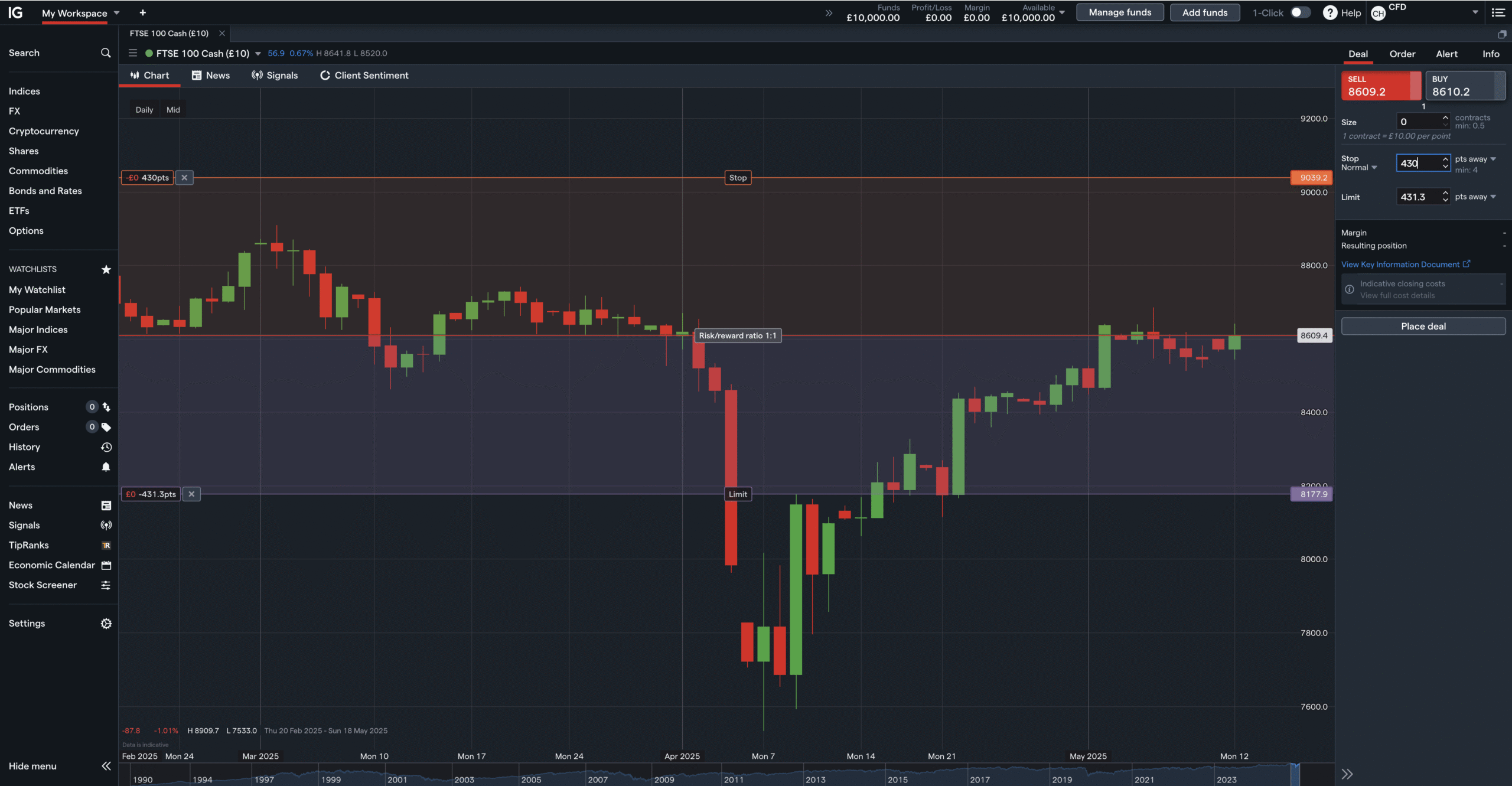
For traders seeking practical tools and flexible market access, global indices and other CFD markets can be explored through MetaTrader 5. Index trading can be combined with forex, metals, shares, commodities, ETFs, and crypto, providing access to multiple financial instruments.
Traders can also use different account options, live pricing, margin and profit calculators, an economic calendar, and demo accounts to understand trading conditions before committing funds. An indices trading account can support access to index markets while desktop, web, and mobile trading platforms provide flexibility for analysis, practice, monitoring positions, and executing trades according to individual strategies and preferences.
What Is Margin in Index Trading?
Margin is the portion of funds required to establish a leveraged position. With contracts for difference, traders do not necessarily provide the entire notional value of the underlying index. Instead, a percentage of that value is reserved as collateral, while leverage creates the remaining exposure.
For example, if an index position has a notional value of $10,000 and the applicable margin requirement is 2%, the required margin would be $200. The trader controls $10,000 of market exposure while setting aside $200. Gains and losses, however, are based on the larger position.
How Margin and Leverage Are Connected
Margin and leverage have an inverse relationship. A 2% margin requirement corresponds theoretically to 50:1 leverage, while a 5% requirement corresponds to 20:1 leverage. Higher leverage can reduce the upfront collateral needed, but it also increases the scale of exposure relative to available capital.
This distinction matters because the margin amount should never be treated as the maximum possible loss. If an index moves sharply against a leveraged position, losses can reduce equity. Margin therefore needs to be considered alongside position size, market volatility, stop loss planning, and available funds.
Why Margin Requirements Can Differ
Margin requirements can vary between indices because instruments have different volatility, liquidity, contract specifications, trading schedules, and market characteristics. A widely followed index may have different requirements from another index with different risk conditions.
During major announcements or rapid price movement, index prices can change quickly. Traders should check the specifications for the individual instrument and account before placing an order instead of assuming that one margin percentage applies everywhere.
Initial Margin and Maintenance Margin
Initial margin is the amount required to open a position. Account equity changes as market prices move.
If a trader opens a position and the market moves against it, unrealized losses can reduce available equity. When funds become insufficient under applicable requirements, a platform may restrict additional orders or close positions according to its terms. Understanding these conditions helps reduce surprises during volatile markets.
Why Free Margin Matters
Free margin represents funds remaining after accounting for margin committed to open positions. It provides room for market fluctuations.
A trader may have a reasonable account balance but limited free margin if several leveraged positions are open. For that reason, monitoring free margin can be more useful than looking at balance alone. Position size, the number of open trades, and correlation between markets should all be considered when assessing total exposure.
Understanding Margin Level
Margin level compares account equity with used margin and is commonly expressed as a percentage. A simplified calculation is equity divided by used margin, multiplied by 100.
For example, if equity is $2,000 and used margin is $500, the margin level is 400%. If losses reduce equity to $1,000 while used margin remains $500, the margin level becomes 200%. A falling margin level can signal excessive exposure.
How Position Size Changes Margin
Position size directly affects required margin. Larger positions generally require more collateral and create larger gains or losses from the same percentage movement in an index.
Before opening a trade, traders should consider equity, acceptable risk, stop loss distance, volatility, and overall exposure. A position may appear affordable because its required margin is small, while its actual market exposure is much larger. Understanding this difference is essential for responsible leveraged trading.
Stop Losses and Margin Management
Stop loss orders can help traders define an intended exit point, but they cannot guarantee that a position will close at exactly that price. In fast markets or during gaps, execution can occur at a different available price.
Traders should understand how their platform handles stop loss orders, market gaps, and periods of reduced liquidity. Margin should be viewed as one part of risk management.
Using Margin Calculators
A margin calculator can simplify trade planning by estimating the funds required for a position. Depending on the tool, calculations may consider the instrument, position size, price, contract specifications, leverage, and applicable margin percentage.
Such tools can reduce calculation errors. However, estimates should not replace checking the current specifications of the selected instrument. Conditions can differ between products and accounts, so traders should confirm requirements before ordering.
Managing Risk Around Margin
Effective margin management starts with controlling exposure rather than using the maximum leverage available. Traders can maintain more free margin by keeping position sizes appropriate, limiting the number of simultaneous trades, and avoiding unnecessary concentration in highly correlated markets.
Several indices can move together during economic announcements. Therefore, opening multiple positions does not automatically mean risk is diversified. Reviewing total exposure and keeping a trading journal can help identify excessive leverage.
Conclusion
Understanding margin requirements helps traders evaluate leverage, position size, available funds, and potential exposure when using an indices trading account. Monitoring free margin and account equity can support more disciplined decisions during changing market conditions. By combining appropriate position sizing with risk management tools and careful market analysis, traders can better understand how leveraged index positions affect their accounts and plan trades more responsibly.
For traders seeking practical tools and flexible market access, Riyadex provides access to global indices and other CFD markets through MetaTrader 5. Its services include index trading alongside forex, metals, shares, commodities, ETFs, and crypto. Traders can also access multiple account options, live pricing, margin and profit calculators, an economic calendar, demo accounts, and MT5 desktop, web, and mobile platforms for analysis, practice, and execution.