In modern metal finishing industries, surface coating technologies play a crucial role in improving durability, corrosion resistance, and visual appearance of steel and aluminum products. Among the most commonly used methods are continuous coil coating systems and powder coating systems. While both serve the purpose of surface protection, they differ significantly in process, application, efficiency, and industrial usage.
A modern colour coating line is widely used for continuous processing of metal coils, offering high-speed production and uniform coating quality. In contrast, powder coating is typically applied to individual parts in batch processes. Understanding the differences between these two systems helps manufacturers select the right solution based on production scale, material type, and performance requirements.
Process Structure and Production Method
The most fundamental difference lies in how the coating is applied and processed.
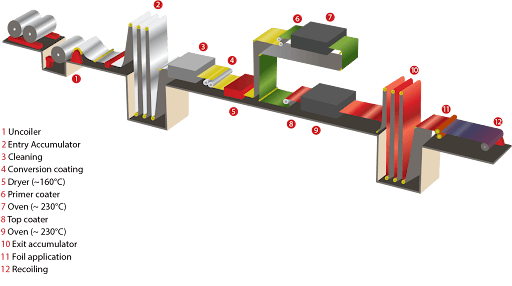
A colour coating line operates as a continuous system where metal coils are unwound, cleaned, treated, coated, cured, and recoiled without interruption. This allows for large-scale production with consistent output quality.
Powder coating, on the other hand, is a batch-based process. Individual metal parts are cleaned, electrostatically sprayed with powder, and then cured in an oven. Each piece is processed separately, which limits production speed but allows for flexibility in smaller batches.
Material Compatibility and Application Scope
Both systems are suitable for metal protection, but their application scope differs.
Colour coating lines are primarily used for:
- Steel and aluminum coils
- Construction materials such as roofing sheets and wall panels
- Appliance-grade metal sheets
- Large-scale industrial production
Powder coating systems are commonly used for:
- Individual metal components and fabricated parts
- Automotive parts and machinery frames
- Furniture and small metal products
- Custom or low-volume production runs
The choice depends largely on whether the production is continuous coil-based or component-based.
Coating Performance and Surface Quality
Coating quality and finish characteristics vary between the two systems.
A colour coating line provides:
- Highly uniform coating thickness
- Smooth and consistent surface finish
- Excellent color stability across large batches
- Strong adhesion due to controlled pretreatment and curing
Powder coating offers:
- Thicker protective layers
- High resistance to impact and abrasion
- Slightly textured surface finish depending on application
- Good edge coverage for complex shapes
Each system has its own strengths depending on the desired final surface properties.
Production Efficiency and Output Capacity
Efficiency is another major point of difference.
Continuous coil coating systems are designed for high-volume production. They can process large quantities of metal sheets with minimal interruption, making them ideal for industrial-scale manufacturing.
Powder coating systems operate at a slower pace because each part must be individually coated and cured. While efficient for small batches or customized production, they are less suitable for continuous high-output requirements.
Environmental and Operational Considerations
Environmental impact and operational efficiency also differ between the two systems.
Colour coating lines often use liquid coatings that may contain solvents, requiring proper emission control systems and wastewater treatment during pretreatment. However, modern systems are increasingly optimized for energy efficiency and low-emission operation.
Powder coating systems are generally considered more environmentally friendly because they produce minimal VOC emissions and allow for powder recycling. However, they still require energy-intensive curing processes.
Cost and Investment Factors
From an investment perspective, both systems have different cost structures.
A colour coating line requires a higher initial investment due to its large-scale equipment, automation systems, and continuous processing design. However, it offers lower per-unit production costs for high-volume manufacturing.
Powder coating systems typically require lower initial investment but may have higher per-unit costs in large-scale production due to slower processing speeds.
Conclusion
Both coating technologies play important roles in modern metal finishing industries, but they serve different production needs. A colour coating line is best suited for continuous, high-volume coil processing with consistent quality requirements, while powder coating systems are ideal for batch production of individual components with flexible design needs. Understanding these differences helps manufacturers choose the most efficient and cost-effective solution for their specific applications, ensuring optimal performance and long-term durability of coated metal products.