
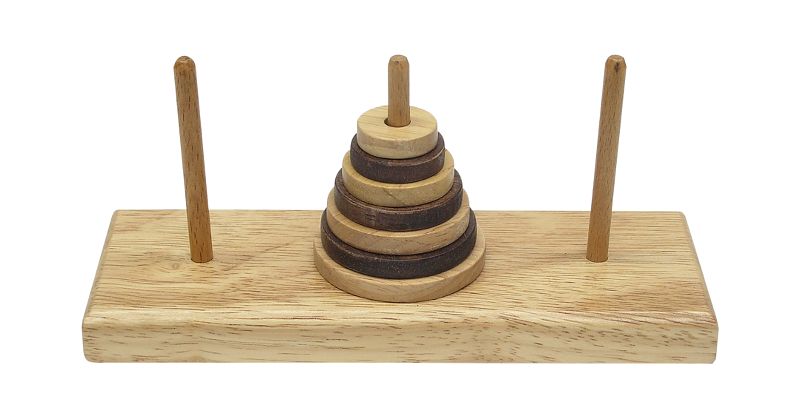
Puzzles have long been valued as enjoyable activities that challenge the mind and encourage creative thinking. From simple matching games to complex mathematical challenges, they offer opportunities to practice patience, concentration, and logical reasoning. One particularly well-known example is the Tower of Hanoi, a puzzle that combines straightforward rules with increasingly challenging problem-solving tasks.
A Wooden Hanoi Tower brings this classic brain teaser into a durable, hands-on format suitable for homes, classrooms, and educational play environments. Players move a stack of differently sized discs between pegs while following specific rules. Although the objective appears simple, completing the puzzle efficiently requires planning, careful observation, and an understanding of how individual moves contribute to a larger solution.
What Is the Tower of Hanoi Puzzle?
The Tower of Hanoi is a mathematical puzzle traditionally consisting of three vertical pegs and several discs of different sizes. At the beginning, all discs are arranged on one peg, with the largest at the bottom and the smallest at the top.
The objective is to transfer the entire stack to another peg while following three basic rules:
- Only one disc can be moved at a time.
- A player can move only the top disc from a peg.
- A larger disc cannot be placed on top of a smaller disc.
These restrictions make the puzzle an interesting exercise in logical thinking. Players cannot simply move discs wherever they want; they must consider the arrangement of the entire stack before making each move.
The puzzle can be completed with a small number of discs for beginners or expanded to create more demanding challenges.
Why Choose a Wooden Hanoi Tower?
Wooden versions offer a practical alternative to puzzles made entirely from plastic or digital formats. Their physical construction makes them suitable for repeated handling and interactive learning.
Durable Construction
A well-made wooden puzzle can withstand regular use when properly cared for. Solid components and smooth finishes contribute to a comfortable playing experience.
Hands-On Learning
Moving the discs physically allows players to see how each action changes the arrangement. This makes abstract ideas about order, sequences, and problem-solving easier to explore.
Simple and Engaging Design
The puzzle typically contains only a few essential components: a base, three pegs, and several discs. Its uncomplicated appearance makes it approachable for beginners while leaving room for more advanced challenges.
Suitable for Different Settings
A wooden Tower of Hanoi puzzle can be used at home, in classrooms, libraries, activity centers, and educational workshops. Its compact design also makes it convenient to store between sessions.
How to Play the Wooden Hanoi Tower
Learning the basic process is straightforward. However, solving the puzzle efficiently requires players to think ahead and understand the relationship between disc movements.
Step 1: Arrange the Discs
Begin with all discs stacked on the first peg. Arrange them from largest at the bottom to smallest at the top.
The remaining two pegs should be empty. One will serve as the temporary storage peg, while the other will be the destination.
Step 2: Understand the Rules
Before moving anything, make sure the three main rules are clear. Only the uppermost disc on a peg can be moved, only one disc can be transferred at a time, and a larger disc must never sit on a smaller one.
Following these restrictions is essential to completing the puzzle.
Step 3: Move the Smallest Stack Carefully
Start by considering which disc needs to move to make space for the larger discs. The solution involves transferring smaller discs between the available pegs so that the largest disc can eventually be moved to the destination.
Step 4: Use the Third Peg
The spare peg is important because it provides temporary storage. Players must use it strategically to prevent larger discs from becoming blocked.
Step 5: Complete the Transfer
Continue moving discs according to the rules until the complete stack reaches the destination peg, with the largest disc at the bottom and the smallest at the top.
Beginners can experiment with a small number of discs before attempting larger configurations.
The Mathematics Behind the Tower of Hanoi
One reason this puzzle is widely used in mathematics and computer science education is its predictable relationship between the number of discs and the minimum number of moves required.
The minimum number of moves can be calculated using the formula:
[
M = 2^n – 1
]
Here, (M) represents the minimum number of moves, while (n) represents the number of discs.
The number of required moves increases quickly as more discs are added.
| Number of discs | Minimum moves |
|---|---|
| 1 | 1 |
| 2 | 3 |
| 3 | 7 |
| 4 | 15 |
| 5 | 31 |
| 6 | 63 |
| 7 | 127 |
| 8 | 255 |
This pattern helps demonstrate exponential growth in a simple, visual way. Students can use the puzzle to explore mathematical sequences and understand why adding just one disc can significantly increase the challenge.
How the Puzzle Develops Logic and Problem-Solving Skills
The Tower of Hanoi is more than a simple stacking activity. Its rules encourage players to analyze situations, identify possible actions, and build a sequence of moves toward a clear objective.
1. Encourages Logical Reasoning
Each move affects the available choices for the next move. Players must understand the rules and determine which actions are possible without creating an arrangement that prevents progress.
Repeated practice encourages structured thinking and the ability to recognize relationships between different parts of a problem.
2. Develops Planning Skills
Players often need to make several temporary moves before they can complete the main objective. This encourages them to think beyond the immediate action and consider the consequences of their decisions.
Planning becomes especially important as the number of discs increases.
3. Improves Concentration
The puzzle requires attention to disc sizes, peg positions, and movement restrictions. A small mistake can disrupt the planned sequence, so players benefit from staying focused throughout the activity.
4. Introduces Pattern Recognition
As players become familiar with the puzzle, they may notice recurring sequences of movements. Recognizing these patterns can help them approach new configurations more efficiently.
5. Encourages Patience and Persistence
The puzzle may take several attempts to solve, particularly when more discs are involved. Players learn that progress often requires careful experimentation rather than random movements.
6. Supports Independent Problem-Solving
Players can work through the puzzle at their own pace, testing possible solutions and correcting mistakes. This provides an opportunity to develop confidence in approaching challenges independently.
Educational Benefits for Children
A wooden Hanoi Tower can be a useful addition to educational play because it combines a clear objective with opportunities to explore mathematical and logical concepts.
Understanding Size and Order
The discs provide a visual way to explore size comparisons and ordering. Children must recognize which pieces are larger or smaller before making a legal move.
Learning Sequences
The puzzle introduces the idea that actions can follow a planned sequence. Children can observe how individual steps contribute to completing a larger task.
Exploring Basic Mathematics
Teachers and parents can use the puzzle to introduce counting, move tracking, number patterns, and the minimum-move formula.
Developing Fine Motor Skills
Picking up and positioning individual discs involves controlled hand movements. Repeated play provides opportunities to practice hand-eye coordination and fine motor control.
Building Confidence Through Achievement
Completing the puzzle can give children a sense of accomplishment. Starting with fewer discs and gradually increasing the difficulty allows them to experience progress as their understanding develops.
Using the Wooden Hanoi Tower in Classrooms
The puzzle can be incorporated into different educational activities, especially lessons involving mathematics, logical reasoning, and introductory computer science.
Mathematics Lessons
Teachers can ask students to count the number of moves needed for different disc arrangements. Students can record their results and look for patterns in the sequence.
Problem-Solving Exercises
Small groups can work together to solve the same configuration. They can discuss possible strategies, explain their decisions, and compare different approaches.
Introduction to Algorithms
The Tower of Hanoi is a classic example used to explain recursive problem-solving. Students can learn that a large task can be divided into smaller versions of the same task.
For example, transferring a stack of discs involves:
- Moving the smaller stack to a temporary peg.
- Moving the largest disc to the destination.
- Moving the smaller stack onto the largest disc.
This approach illustrates how a complex task can be solved through a repeated sequence of simpler steps.
Independent Learning Stations
Teachers can place the puzzle at a classroom activity station. Students can attempt different disc arrangements, track their moves, and challenge themselves to find efficient solutions.
Choosing a Quality Wooden Hanoi Tower
Selecting an appropriate puzzle involves considering its construction, design, size, and intended users.
| Buying consideration | What to look for |
|---|---|
| Wood quality | Strong, well-finished material |
| Base stability | A firm base that stays in position |
| Peg construction | Secure pegs with smooth surfaces |
| Disc finish | Smooth edges without splinters |
| Disc variety | Clearly different sizes |
| Number of discs | Suitable difficulty for the intended players |
| Component fit | Discs that move easily over the pegs |
| Storage | A compact design that keeps components organized |
| Safety | Appropriate materials and finishes for the intended age group |
Check the Wood and Finish
The base, pegs, and discs should have smooth surfaces without sharp edges or loose components. A suitable finish can improve durability and make the pieces more comfortable to handle.
Consider the Number of Discs
The number of discs determines the difficulty of the puzzle. A smaller set is usually more approachable for beginners, while a larger set creates a greater challenge for experienced players.
Look for a Stable Base
A stable base helps prevent the puzzle from moving while discs are being transferred. This is particularly useful for younger players who are still developing precise hand movements.
Check Component Quality
The discs should fit comfortably over the pegs without becoming stuck. Components that are too loose or poorly finished can make the activity frustrating.
Fun Ways to Make the Puzzle More Challenging
Once players understand the basic rules, they can introduce additional activities to make the puzzle more engaging.
Set a Move Limit
Ask players to complete a puzzle using the minimum number of moves. This encourages them to think carefully before moving a disc.
Use a Timer
Introduce a time challenge for players who already understand the rules. The aim should be to improve planning and familiarity rather than create unnecessary pressure.
Increase the Number of Discs
Begin with three discs and gradually add more. This provides a clear progression in difficulty.
Organize a Friendly Competition
Two or more players can attempt the same configuration and compare their solutions. Encourage participants to explain their strategies instead of focusing only on speed.
Record the Moves
Players can write down each move using the names or numbers of the pegs. This is particularly useful for classroom activities involving sequences and algorithms.
Caring for and Maintaining a Wooden Hanoi Tower
Proper care helps keep the puzzle in good condition and ensures that its components remain comfortable to handle.
- Wipe the wooden pieces with a soft, dry or slightly damp cloth when necessary.
- Avoid soaking the components in water.
- Keep the puzzle away from prolonged moisture and excessive heat.
- Store the discs and base in a clean, dry place.
- Check regularly for loose pegs, cracks, or damaged edges.
- Follow the manufacturer’s cleaning and maintenance instructions.
For puzzles used by children, adults should inspect the components periodically and remove any damaged pieces from use.
Conclusion
The Wooden Hanoi Tower is a classic puzzle that combines simple materials with an engaging mathematical challenge. By moving differently sized discs between three pegs while following clear rules, players practice logical reasoning, planning, concentration, pattern recognition, and persistence.
Its educational value makes it suitable for homes, classrooms, libraries, and learning centers. A well-designed wooden version also offers a hands-on experience that allows players to explore mathematical sequences and problem-solving strategies at their own pace.
When choosing a set, consider the quality of the wood, stability of the base, smoothness of the discs, and number of pieces. With suitable equipment and gradually increasing challenges, this timeless puzzle can provide an enjoyable way to develop thinking skills through interactive play.